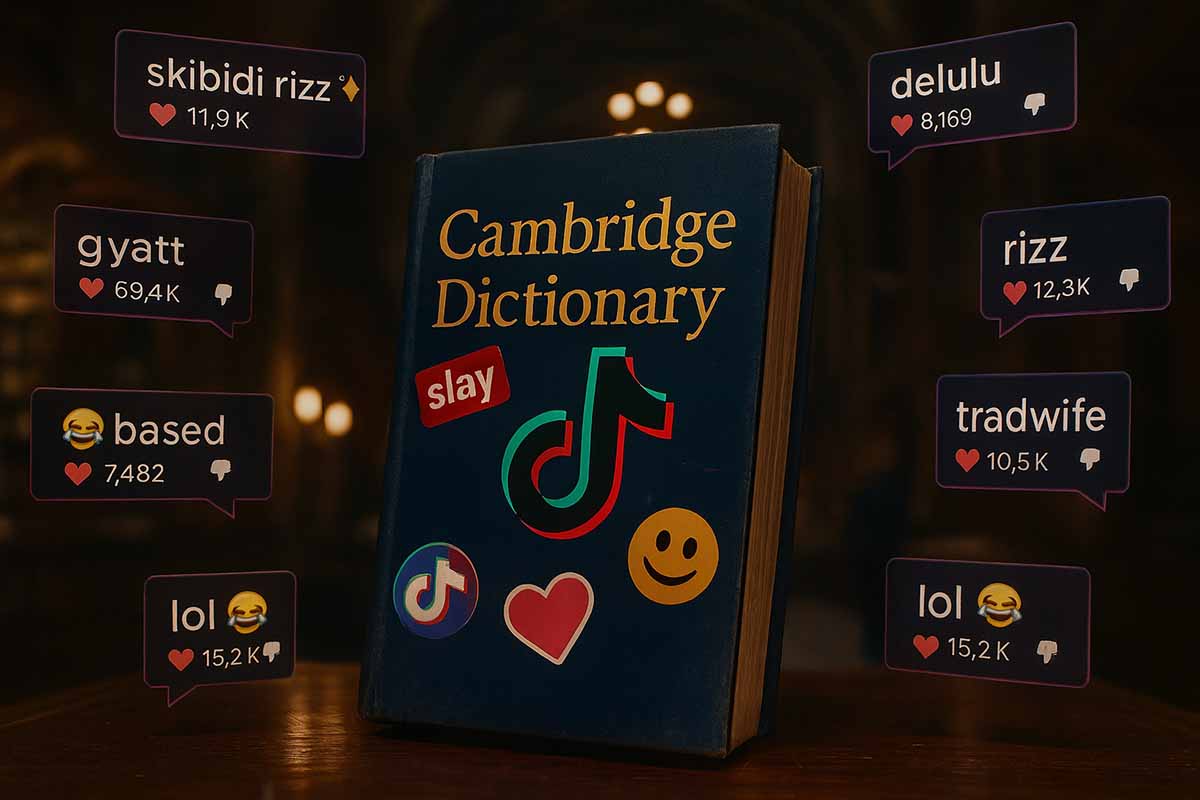
CAMBRIDGE, ENGLAND – In a bold move that scholars are already describing as “a cry for help,” the Cambridge Dictionary announced it has added over 6,000 new words and phrases—effectively transforming itself into a bound, hardback TikTok comment section.
Among the fresh entries: skibidi, a nonsense syllable birthed from an unholy union of meme culture and YouTube toilet animation; tradwife, the aspirational hashtag for women rediscovering the 1950s via Instagram filters; and delulu, which is apparently not a typo but rather the spiritual diagnosis of our times.
“We’ve always strived to capture the living language,” said one exhausted Cambridge editor, clutching an iced matcha. “Unfortunately, the language is now living in its mom’s basement, watching anime, and occasionally yelling skibidi toilet at strangers.”
Not everyone is pleased. One critic noted, “If Shakespeare were alive today, he’d be forced to explain whether Hamlet’s soliloquy was simply ‘delulu.’” Meanwhile, English professors across the globe are reportedly Googling “mouse jiggler” during office hours, trying to understand how it earned equal billing with words like justice and honor.
Online reaction has been swift. Traditionalists see the additions as proof that civilization is collapsing, while Gen Z users are celebrating with comments such as “slay, dictionary queen” and “English is no longer a language, it’s a vibe.”
Cambridge insists the words reflect “real usage” in modern communication, though some linguists fear the 2030 edition will be nothing but emojis and keysmash: “ahsldkjf.”
At press time, Webster’s was rumored to be retaliating with its own additions, including “mid,” “based,” and the ever-elusive “no cap.” Critics warn that once “Skibidi rizz gyatt” makes the cut, the Oxford comma itself may file for early retirement.